
| The Foundation |
 Purpose Purpose |
| Trustees |
| Secretariat |
| Committee
members |
| The Centre |
| History |
| Description |
| Location |
| The Activities |
| Current schedule |
| Past
activities |
| Last
principal conferences |
| Publications |
| Building Bridges through Music
Gaurav Mazumdar - a profile
|
| Scholars in residence |
| Recent samples of scholars' work |
| Study grant |
| Fellows |
| Dr.
B.G. Shrestha’s
experience |
| Links |
| Contact |
|
Current schedule
2025
Building Bridges through Music
14-26 October 2025
This ensemble offers a unique opportunity for intercultural musical exchange. Musicians from various cultures and genres come together at a historic venue in the Centro Incontri Umani in Ascona to explore their musical traditions and engage in dialogue over ten days. The goal is to develop new artistic synergies through the exchange of compositions and collaborative experimentation with sounds. The result of this intense collaboration culminates in five concerts that reflect the diversity and connections of global music cultures.
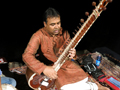
This year the musicians are Carles Muñoz Camarero (Spain - nyckelharpa, voice, cello), Loris Imlig (Switzerland - Schwyzerörgli), Gaurav Mazumdar (India - sitar), Marina Liontou Mochament (Greece - oud), Mirva Ormin (Finland - johikko, violin, vocals), Andrej Prozorov (Ukraine - woodwind) and Bernhard Schimpelsberger (Austria - percussion).
This project is run through the Foundation Centro Incontri Umani, Director Angela Hobart. The musical leader is Gaurav Mazumdar and the curator is Roman Britschgi.
Concerts:
Thursday, 23 October 2025, Jazz in Sarnen, Sarnen, CH
Friday, 24 October 2025, 8:00pm, Kartell Culturel, Biel, CH
Saturday, 25 October 2025, 8:00 pm, La Fabbrica, Losone, coll. Grin Festival, CH
Sunday, 26 October 2025, 3:30pm, Chiesa di Loco, CH
Interface Masterclass: Impact Films Retreat
7-11 August 2025
In conjunction with the Locarno Film Festival, a masterclass on transformational and impactful storytelling techniques.
Techniques Fabuleuses Writing Residency
14-24 July 2025
A wide array of experimental practices are currently emerging in the laboratories of the performance arts (in dance studios, performance spaces, and research-creation contexts). We call these practices 'fabulous techniques' because they offer playful and speculative ways of sensing, acting, and thinking differently. Divination, telepathy, clairvoyance, and trans-individual agencies are among the fabulations that inspire these practices, where the usual boundaries between subject and world, facts and fictions, artwork and artistic process are unsettled. The games these practices offer propose a transformation of sensibility and place relation at the heart of creation.
A research project by Mathieu Bouvier and Loïc Touzé, La Manufacture, haute école des arts de la scène - Hes.so, Lausanne;
with Alice Godfroy, Université Côte d'Azur; Jérémy Damian, University of Grenoble; Claire Vionnet, Centre for Dance Research (C-DaRE), Coventry University; Yasmine Hugonnet, Mathilde Papin and Julien Bruneau.
Interface: Minority Heritage, Social Inclusivity, and Epistemic Justice in Asian Museum Representations
8-12 July 2025
A writing retreat.
Interface: Violence against Environmental Defenders in Mining
30 June - 5 July 2025
A writing retreat.
Interface: Ascona Summer School
16 - 19 June 2025
A joint summer school between the Universities of Copenhagen and Geneva (both 4EU+ Alliance members) exploring the field of green activism with a specific focus on different forms in the context of changing discourses of criminalization, engagement, radicalism and extremism.
Interface: Anthropologies of Activism and Advocacy
13 - 15 June 2025
A writing retreat.
Crisis, Sacrifice and Redemption: Reconfiguring Communities of Trust
8 - 12 March 2025
A seminar series and workshop, organised by Professor David Nugent (Emory University).
2024
Building Bridges through Music
15-27 October 2024
This event is a unique musical encounter and collaboration, bringing musicians from different backgrounds and genres together. Seven accomplished musicians from diverse traditions will be stay together for 13 days as residential artists at the Centro Incontri Umani in Ascona. They rehearse, share their compositions, exploring and creating new stories and sounds, before performing together for the audience at different venues in Switzerland.
This year the musicians are Suyean Ha (South Korea - gayageum), Gaurav Mazumdar (India - sitar), Marina Liontou Mochament (Greece - oud), Mirva Ormin (Finland - johikko, violin, vocals), Andrej Prozorov (Ukraine - woodwind), Pamelia Khadijah Stickney (USA - cello) and Adrian Würsch (Switzerland - Schwyzerörgeli).
This project is run through the Foundation Centro Incontri Umani, Director Angela Hobart. The musical leader is Gaurav Mazumdar and the organizers are Roman Britschgi and Francesco Giudici.
Concerts:
Sunday, 20 October 2024, Film Festival Dei Diritti Umani, Lugano, CH
Thursday, 24 October 2024, 8:30pm, Jazz in Sarnen, Sarnen, CH
Friday, 25 October 2024, 8:00pm, Chiesa di Loco, Loco, CH
Saturday, 26 October 2024, 8:30pm, RSI Auditorium, Lugano, CH
Sunday, 27 October 2024, 3:30pm, Centro Internazionale di Scultura, Peccia, CH
Interface Commission: Engaged Anthropology
27-29 September 2024
Organizational meeting.
Psychoid Processes and the Mind-Matter Problem: Revisiting Carl Jung and Commemorating Giles Clark
9-12 September 2024
A workshop organised by Dr Judith Pickering and Prof. Geoffrey Samuel.
Transformational Charter Building
3-6 June 2024
A workshop by Interface Commission.
 Account on the Interface website
Writing retreat
13-16 February 2024
A workshop on the book project 'Intersections of Engaged and Decolonial Anthropology' held by the Interface Commissiony.
2023
Building Bridges through Music
16-29 October 2023
This event is a unique musical encounter and collaboration, bringing musicians from different backgrounds and genres together. Seven accomplished musicians from diverse traditions will be staying together for 14 days as residential artists at the Centro Incontri Umani in Ascona. They will be rehearsing, sharing their compositions, exploring and creating new stories and sounds, before performing together for the audience at different venues in Switzerland and Italy.
This year the musicians are Fan Qi Wu (Taiwan/Sweden - pipa, voice), Sanne Huijbregt (Netherlands - percussion, voice), Gaurav Mazumdar (India - sitar), Marina Liontou Mochament (Greece - oud), Nicolo Bottasso (Italy - trumpet, violin), Simone Bottasso (Italy/Netherlands - accordion, flute) and Roman Britschgi (Switzerland - bass).
This project is run through the Foundation Centro Incontri Umani, Director Angela Hobart. The musical leader is Gaurav Mazumdar and the organizer is Johannes Rühl.
Concerts:
Friday, 27 October 2023, 8:00pm, Chiesa di Loco, Valle Onsernone, CH
Saturday, 28 October 2023, 5:00pm, Teatro Clinica Psichiatrica Cantonale, Mendrisio, CH
Saturday, 28 October 2023, 8:30pm, Cinema Teatro, Chiasso, CH
Sunday, 29 October 2023, 5:00pm, Centro Internazionale di Scultura, Peccia, CH
Movement, health and resilience: a new approach for the mid-twenty-first century
24 August - 3 September 2023
A workshop organised by Ann R. David (Roehampton University, UK) and Geoffrey Samuel (Cardiff University, UK/University of Sydney, Australia)
Ascona Summer School - Critical Sustainability Engagements: Anthropological Perspectives on Theory and Practice
13-16 June 2023
Organised by the Interface Commission.
Account on the Interface website
Decolonial Engagements? Exploring the Intersections of Engaged and Decolonial Anthropology
10-12 June 2023
A colloquium at the Centro Incontri Umani organised by the Interface Commission and supported by the Swiss Academy of Humanities and Social Sciences.
2022
Building Bridges through Music
18 - 30 October 2022
This event is a unique musical encounter and collaboration, bringing musicians from different backgrounds and genres together. Seven accomplished musicians from diverse traditions will be staying together for 14 days as residential artists at the Centro Incontri Umani in Ascona. They will be rehearsing, sharing their compositions, exploring and creating new stories and sounds, before performing together for the audience at different venues in Switzerland and Italy.
This year the musicians are Fan Qi Wu (Taiwan/Sweden - pipa, voice), Sanne Huijbregt (Netherlands - electronic, voice), Oscar Antoli (Spain/Austria - clarinet), Gaurav Mazumdar (India - sitar), Bo Wiget (Switzerland/Germany - cello), Nicolo Bottasso (Italy - trumpet, violin) and Simone Bottasso (Italy/Netherlands - accordion).
This project is run through the Foundation Centro Incontri Umani, Director Angela Hobart. The musical leader is Gaurav Mazumdar and the organizer is Johannes Rühl.
Concerts:
Friday, 28 October 2022, 8:00pm, Chiesa Loco, Valle Onsernone, CH
Saturday, 29 October 2022, 5:00pm, Teatro Clinica Psichiatrica Cantonale Mendrisio, CH
Saturday, 29 October 2022, 9:00pm, Officina della Musica, Como, IT
Sunday, 30 October 2022, 5pm, Teatro San Materno, Ascona, CH
Imagining New Anthropological Futures
17-18 September 2022
A colloquium at the Centro Incontri Umani organised by the Interface Commission and supported by the Swiss Academy of Humanities and Social Sciences.
Time and the ethnographic horizon in moments of crisis
9-11 September 2022
A workshop at the Centro Incontri Umani organised by Dr Tony Crook, Deputy Director of the Balzan Research Project 'Ethnographic Horizons'.
Rethinking bodymind techniques in and beyond Asia: An integrated approach through anthropology, movement studies and neuroscience
24 June - 1 July 2022
A workshop organised by Ann R. David (Roehampton University, UK) and Geoffrey Samuel (Cardiff University, UK/University of Sydney, Australia)
2021
Building Bridges through Music
15 - 25 October 2021
This event is a unique musical encounter & collaboration, bringing musicians from different backgrounds and genres together. Six accomplished musicians from diverse traditions will be staying together for 14 days as residential artists at the Centro Incontri Umani in Ascona. They will be rehearsing, sharing their compositions, exploring and creating new stories and sounds, before performing together for the audience at different venues in Switzerland and Italy.
This year the musicians are Xu Gengxia (China/Germany - Guzheng), Oscar Antoli (Spain/Austria - clarinet), Gaurav Mazumdar (India - sitar), Bo Wiget (Switzerland/Germany - cello), Nicolo Bottasso (Italy - trumpet, violin) and Simone Bottasso (Italy/Netherlands - accordion).
This project is run through the Foundation Centro Incontri Umani, Director Angela Hobart. The musical leader is Gaurav Mazumdar and the organizer is Johannes Rühl.
Concerts:
Friday, 22 October 2021, 8:00pm, Chiesa Loco, Valle Onsernone
Saturday, 23 October 2021, 8:45pm, Teatro Sociale, Bellinzona
Sunday, 24 October 2021, 5pm, Centro Internazionale di Scultura Peccia, Peccia
The Ascona Interface Summer School, Anthropological Engagement Beyhond Academia
15-25 October 2021
The IFC Summer School, is the first of its kind in Switzerland, and aims to offer students a space to learn about contemporary anthropological engagement and practice beyond academia.
2020
Building Bridges through Music
13 - 26 October 2020
This event is a unique musical encounter & collaboration, bringing musicians from different backgrounds and genres together. Six accomplished musicians from diverse traditions will be staying together for 14 days as residential artists at the Centro Incontri Umani in Ascona. They will be rehearsing, sharing their compositions, exploring and creating new stories and sounds, before performing together for the audience at different venues in Switzerland and Italy.
This year the musicians are Sofia Hoffmann (Portugal - vocalist), Oscar Antoli (Spain/Austria - clarinet), Gaurav Mazumdar (India - sitar), Bo Wiget (Switzerland/Germany - cello), and Olena Yeremenko (Ukraine - Nyckelharpa).
This project is run through the Foundation Centro Incontri Umani, Director Angela Hobart. The musical leader is Gaurav Mazumdar and the organizer is Johannes Rühl.
Concerts:
Sunday, 25 October 2020, 5:00 pm, Teatro San Materno, Ascona, CH
 |
 |
 |
 |
 |
 |
 |
 |
 |
 |
 |
 |
 |
 |
 |
 |